


Tips to help you network more effectively
We advise a lot of our clients on how to raise their profile by attending events. As a result of this, one topic that I am often asked about is networking. In fact, the funny thing is that so many clients ask me how they can improve their networking skills, yet each one feels that they’re completely alone in their struggle. This couldn’t be further from the truth! Many people feel nervous, apprehensive or plain horrified at the prospect of attending a networking event. It is easy to forget that when you walk into the room, everyone else there is in the same boat. The good news is that there are steps that you can take to make networking easier and even (gasp!) enjoyable. Read on for my top tips for networking more effectively.
Get your pitch clear
Before you attend the event, get your pitch clear. You can even try rehearsing it aloud, to get yourself used to communicating what it is that you do. Remember to focus on the ways that you help your clients and customers. Once you are confident in pitching, you can also start to tailor your pitch to whoever you’re speaking to, making them more likely to request your services.
Arrive early
Walk into a busy room can be intimidating, especially when it seems that everyone is already talking to each other. Arrive first and you’ll get the chance to speak to whoever comes through the door next. Arriving early is also a good approach if you want to catch the organiser or a speaker before everyone else does!
Divide and rule
It can be reassuring to attend a networking event with a business colleague or friend, but remember, it is best to plough your own furrow. Avoid standing in a corner and talking shop. This will deter potential contacts from approaching you. Be brave! Split up and get stuck in.
Quality over quantity
A networking event isn’t a race to collect as many business cards as possible. Although it might be tempting, one or two really good connections will be more beneficial. Don’t be in a rush to move around the room. Take your time and make sure you are fully engaged with whoever you’re talking to. If they get the sense that you’re itching to move on, they won’t feel valued.
Listen
An easy way to shift the focus from yourself (and calm your nerves!) is to make the conversation about the person with whom you’re speaking. Ask them about their challenges and really listen to what they tell you. The best way to actively listen is by maintaining eye contact, so don’t be tempted to look over their shoulder at who else is in the room. By really listening to the person you’re speaking to, you’ll show that you care and it helps you to stand out from those talking about themselves.
Ask open questions
Asking open questions will help you to keep the conversation flowing. Open questions are more thought-provoking and should lead to a more engaging conversation. You could ask some of the following:
- What products or services does your company offer?
- Who are your clients?
- How are you different from the competition?
- How is the sector changing?
Wrap things up the right way
Of course, there will be times when you’re ready to leave a conversation. Don’t be afraid to move on but remember, the way that you say goodbye is important. Keep your farewell polite, genuine and warm by saying something along the lines of ‘It has been great to meet you. I’d better do the rounds and meet a few more people before the evening is over.’ Don’t forget to leave your business card!
Don’t be afraid of small talk
Remember it is perfectly fine to just have a chat! If it seems like the person you’re speaking to has no inclination to talk about business, don’t view it as a lost opportunity. You can still make an impact by finding some common ground or just making them laugh. And give them a business card so that you can follow up another time.
Finally, be human
People don’t attend a networking event to connect with a walking CV. The best way that you can make an impact is by having an honest connection with the people you’re talking to. Stop thinking too much about what you’re going to say, how you look, or what others might be thinking. Just being your true, self will help you to build a connection.
So remember, when you’re attending a networking event, you’re not the only person who is feeling nervous. Networking is a set of skills that anyone can learn. Good networks are built on good relationships first and foremost. Keep this in mind every time you approach a new networking opportunity and remember; the person next to you could just be your new favourite client.
If you have any questions, or you'd like to know more about how networking could benefit you and your organisation, get in touch.

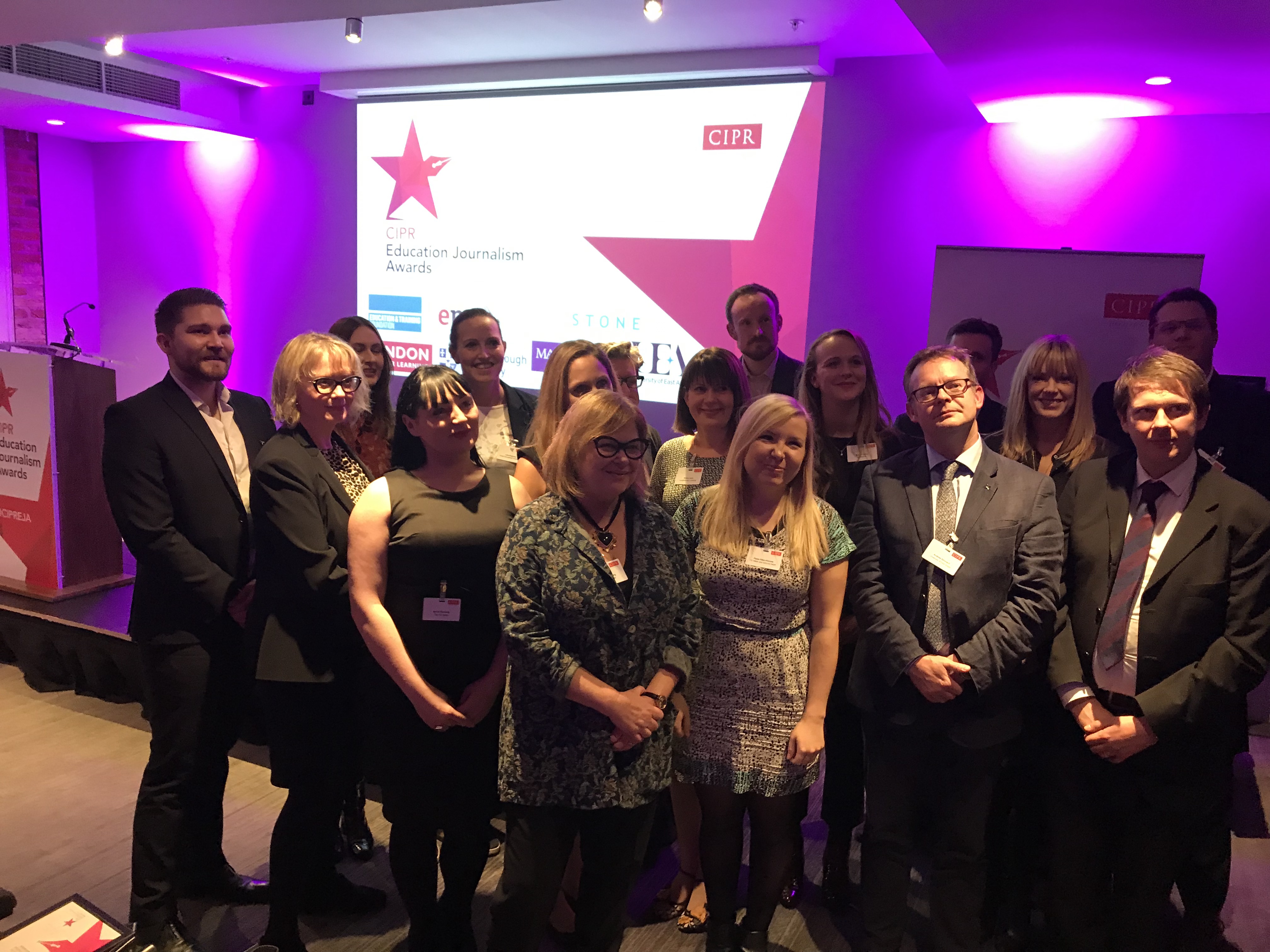
CIPR Education Journalism Awards: The Lowdown
We were delighted to attend the CIPR Education Journalism Awards on 22 November 2018 in London. The awards have been taking place since 2005, powered completely by volunteer effort from the CIPR’s Education & Skills group. The group was founded to support PR and communications professionals working in the sector.
It is rare for education journalists to gather in such a concentration, so it was wonderful to be there to meet and congratulate all those that were shortlisted, runners-up and winners.
Here’s the lowdown…
Most promising newcomer to education journalism
Winner - Pippa Allen-Kinross, FE Week and Schools Week
Runner-up - Kerrie Kennedy, The PIE News
Outstanding schools journalism
Winner - Sarah Montague, BBC Radio 4 World at One
Runner-up – Charlotte Santry, TES
Outstanding further and vocational education journalism
Winner - Julia Belgutay, TES
Runner-up - Billy Camden, FE Week
Outstanding higher education journalism
Winner – John Morgan, THE
Runner-up – Tom Bartlett & Nell Gluckman, The Chronicle of Higher Education
Outstanding regional journalism
Winner – Emma Seith, TES Scotland
Runner-up - Helen Steel, ITV Calendar News
Outstanding national education journalism
Winner – Louise Tickle, The Guardian
Runner-up – Jon Severs, TES
TED Wragg award for outstanding contribution to education journalism
Judy Friedberg, The Guardian
As specialists in education PR, it is this group of journalists that we engage with the most. We really appreciate the work they do, in reporting and investigating education. The amount of time that the media devotes to education has decreased in the last few years, so congratualtions to this trusty group of journalists that write daily about the subject closest to our hearts. You help to hold to account education institutions, government officials, politicians and the myriad of other organisations involved in education. Bravo!